The village of Slingsby is located on the edge of the Howardian Hills, 15 miles to the north of York.
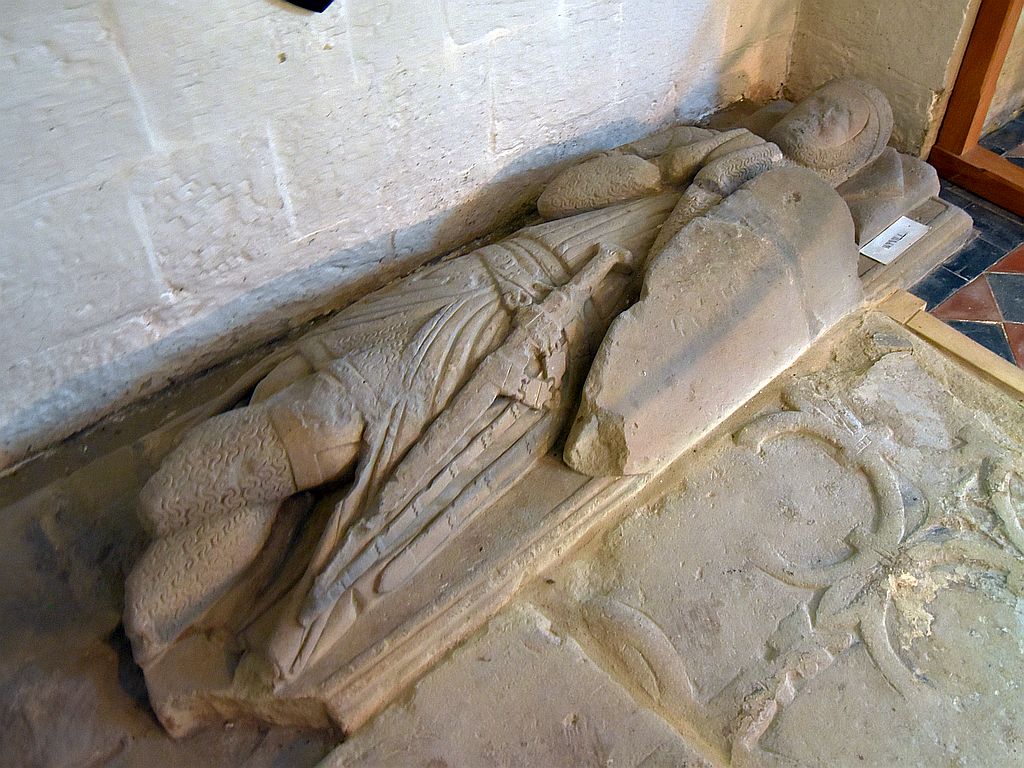
In the early 1600’s, the antiquarian Roger Dodsworth visited Slingsby church and noted a stone memorial to a knight which had an interesting story connected with it …
“There is in the choir a monument cross legged of one of the Wyvilles, at his feet a Talbot couching (a dog laying), no inscription, a shield on his arm with 3 chevrons and a top band depicted, the colours hard to see. There is in the east end of the towne an old house of stone called Wyville hall.
The tradition is that betwixt Malton and this town there was sometime a serpent that lived upon pray of passengers, which this Wyville and dog did kill, when he received his deaths wound. There is a great hole half a mile from the town, round within and 3 yards broad and more, where this serpent lay in which time the street was turned a mile on the south side, which doth still show itself if any take pains to search it.”

Three hundred years later, the rector of Slingsby – Arthur St. Clair Brooke, included Dodsworth’s description in his book ‘Slingsby and Slingsby Castle’ (Brooke 1904). Brooke goes on to mention that the serpent story still existed in the village, but the details no longer matched those described by Dodsworth …
“There are difficulties arising out of these statements of Dodsworth, for the hole which is now known as the serpent’s hole is twenty-one yards broad by eighteen yards long, and fully a mile from the town. It is situated on the southern edge of Low Pot Close, and in such a position that a turning of the Malton Road to the south would be turning the road towards, and not away, from the lair of the serpent ; but by the street that was turned Dodsworth may have meant not the Malton Road but the trackway by the entrenchment, ….”
These differences are perhaps no surprise after 300 years, as oral traditions are known to change and adapt over time. The ‘serpent’s hole’ mentioned by Brooke in 1904 was an old gravel pit in a field to the south of the modern road to Malton, but being located one mile from Slingsby, it is actually nearer the village of Barton Le Street. Although still marked on the OS map, this pit has long been filled in, and years of cultivation in the field have left only a slight depression, which occasionally shows up as a crop mark on aerial images. This infilling must have happened some years ago, as the current land owner did not know about the old gravel pit, and had not heard the story of the Slingsby serpent either.

Brooke realised that this gravel pit did not match Dodsworth’s original description for its size or location, and he also suggested that Dodsworth’s ‘Street’ was an older route which ran along the ridge of high ground to the south of Slingsby. It seems that Dodsworth may have actually been referring to the ancient bank and ditch earthwork which runs for over a mile along this hill in the direction of Malton, and does have the appearance of being a sunken trackway. Although very overgrown, it is well preserved in the wooded areas on the ridge, and this would match the ‘Street’ “… which doth still show itself if any take pains to search it.”
The Serpent’s lair
“betwixt Malton and this town there was sometime a serpent …. There is a great hole half a mile from the town ….. where this serpent lay, in which time the street was turned a mile on the south side ….”
Dodsworth’s description seems to point to the serpent’s lair being located half a mile to the east of Slingsby, near the old Roman road to Malton (the current B1257), from where the snake could attack people passing by. Because of this danger he also noted that the road was diverted to the south (up Slingsby Bank) to avoid passing the serpent’s hole.
Checking the OS map shows that there is actually an old quarry hole by the roadside half a mile to the east of the village, so was this the original serpent’s lair?

Dodsworth’s manuscript described the lair as ‘a great hole …. 3 yards broad and more’, however a hole 3 yards across does not sound particularly ‘great’, and the wording suggests that he meant a larger number – probably 30 yards, but the zero is missing for some reason. (The YAS transcription of Dodsworth’s manuscript does note that his writing was often ‘rough and confused’ and did contain errors.)
So a ‘great hole … half a mile from the town, round within and 30 yards broad and more‘ could well describe the old quarry by the road – if it existed in Dodsworth’s day. The quarry is dug into a low hill in the field, and there are several large holes where the limestone bedrock has been removed in the past. One of these holes could have been the ‘Serpent’s lair’, although later quarrying may have altered the site.
By describing the Serpent’s Hole as being ’30’ yards wide and ’round within’, Dodsworth may have also been indicating the great size of the serpent as it lay coiled within its lair. This would tie in with the local belief that the serpent was one mile in length – as noted by Parkinson in his Yorkshire Legends and Traditions (1888). At this point such a huge snake begins to takes on more legendary proportions – a enormous monster with an appetite for eating cattle and people, while generally terrorising the area, until a brave knight sallied forth to fight it to the death.
Roman origins?
The fine limestone in this area is known to have been quarried in Roman times to provide stone for the buildings in Malton (Roman Derventio), and the Roman road passing Slingsby would provide easy access to any quarries in this area. It is also worth noting that Roman quarries often had a shrine or altar dedicated to the guardian spirit of the area (the genius loci), and that serpents were a symbol associated with these spirits. These shrines might just be a niche and altar carved into the quarry rock face, along with the image of a deity or an inscription. Serpents can be found carved on several stone altars from Roman shrines in other parts of Britain, and they were usually connected with a local deity – as in the Verbeia altar at Ilkley.

So could this have been the origin of the Slingsby serpent legend? – an overgrown and long forgotten Roman quarry, with perhaps a figure holding a serpent carved onto the rock face? It is easy to see how villagers in later times would create a story to explain such a curious feature in their parish.
After notes
As is often the case with old folklore, the details seem to have been quite ‘flexible’, and in this case the serpents lair appears to have changed location in the 3 centuries after Dodsworth first described it. In his day it was a ‘great hole’ half a mile from the village, but by 1904 it was a gravel pit in a field one mile away, and not visible from the road. It is possible that as this was the serpent’s ‘patch’, then both locations were connected with it. Dodsworth was accurate with his measurement of 1 mile to the old route to the south of Slingsby, so his half mile to the serpent’s lair should be reliable.
For a while i did wonder when Dodsworth described ‘a great hole ….. 3 yards broad and more …. and round within‘ if he was actually referring to a hole of ‘great’ depth, such as a deep cave or tunnel-like opening leading into the hillside. But again the wording suggests that the ‘3 yards’ was an error, and most likely 30 was meant.
It is also possible to read Dodsworth’s brief description as placing the serpent’s lair half a mile to the south of Slingsby … “a great hole half a mile from the town, ….. where this serpent lay, in which time the street was turned a mile on the south side“. This would place the lair on Slingsby Bank, and interestingly there is an old quarry by the road at this location too. This small quarry is no longer used, and is now overgrown with trees, but it was originally cut into the slope of the hill side to expose a rock face around 5m in height. The road up Slingsby Bank ‘snakes’ passed the edge of the quarry, and the location does have a certain atmosphere that i have noticed elsewhere. So perhaps this was the ‘great hole’ where the serpent lay in wait for passers-by?

References
Brooke, A. (1904) Slingsby and Slingsby Castle (Internet Archive link)
Dodsworth, R. Yorkshire Church Notes (1619 – 1630) Yorkshire Archaeological Society 1904.
Parkinson, T. (1888) Yorkshire Legends and Traditions. Internet Archive link

