Up until the early 1900’s Adel was a small village 4 miles to the north of Leeds. Since that time the city has expanded and swallowed up Adel and several other villages, which now form the cities northern suburbs. An area of old woodland still remains on a hillside between Adel and Alwoodley, and near the top of this hill there is a large boulder with the outline of a warrior carved upon it. It is thought that this figure represents the Celtic god Cocidius, and that the carving dates back to the Romano-British period.
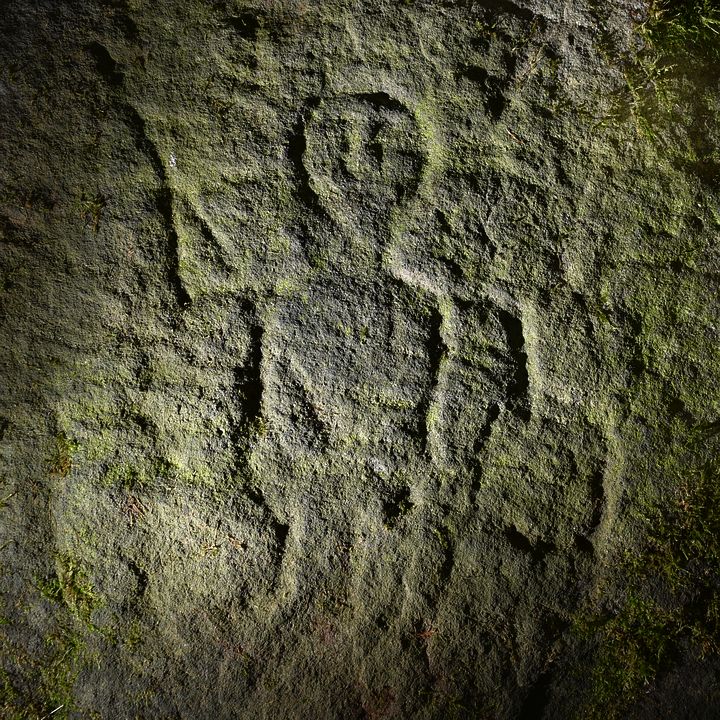
Cocidius was a god of the native Britons who lived in the north of England at the time of the Roman invasion. With the building of Hadrian’s Wall, the Roman military presence in that area led to the name Cocidius being recorded on over twenty stone altars. Before the invasion, the religion of the native population left few traces, however the Roman practice of building shrines dedicated to their own gods and also the local deities has preserved the names of several native British gods. When found in Latin inscriptions these native deities are usually linked with a Roman god with similar attributes, and in the case of Cocidius he was linked with the Roman god Mars. Mars was the god of war and also agriculture – two very different areas of life, but the original belief seems to have been in a strong and virile warrior god whose role was to protect the Roman people. His virile guarding force also extended to agriculture – protecting the growth of crops from the spring month of Mars (March) through to harvest time in the autumn.

The Romans took Cocidius to be a local version of their god Mars – standing on guard with his spear and shield ready for action, while the name Cocidius also had a link with the Roman god. Cocidius translates as the ‘Red one’, and Mars was also associated with the colour red, leading to Mars – ‘the red planet’, being named after him. This link with red is said to signify the blood spilt by the warriors weapons, although red is also the very colour of life and vigour, so Mars and Cocidius were gods who had the power to protect and promote life, as well as end it.

Cocidius at Adel
The altar dedications to Cocidius near Hadrian’s Wall were linked with the Roman military presence in that area, and this seems to have also been the situation at Adel. A Roman road and military camp with an adjoining settlement were located 1km to the north-west of the hillside where the warrior carving was made on the rock. The old OS maps also mark a second camp a similar distances to the south east of the carved rock, so the warrior figure was mid way between these two Romano-British sites. The remains of boulder walling have been noted to the west of the carving, and this actually connects to the western end of the carved outcrop. At this point there is also an arrangement of stones against the back of the outcrop which may be the remains of a structure. A little further up the hill there is also a suspiciously flat and level area, and to the west of this there is another setting of low stones, along with the possible remains of a small cairn. These features are not very obvious, but they may be the all that remains of structures once connected with the Cocidious carving – possibly even a shrine.

Warrior ‘cousins’ further north
At South Yardhope (18 miles to the north of Hadrian’s Wall) there was another Roman road and military camp in a quite remote moorland location. On a hillside 1 mile to the south east of the camp there is a large boulder with a carving of a warrior holding a shield and a spear, and this is also thought to represent Cocidius. A gap in the outcrop alongside the carved boulder was used to create a small roofed chamber approximately 2m square inside. An archaeological investigation of the site concluded that this had been a native British shrine, probably predating the arrival of the Roman army in the area, when the warrior figure was then engraved next to the shrine entrance. Further support for the warrior figure being identified as Cocidius comes from the shrine’s location in the valley of the Holystone Burn in upper Coquetdale. The river Coquet name translates as the ‘red river’, with earlier forms of the name – Cocuedi and Cocueeda hinting at a link with Cocidius (the Red One’), who may well have been the tutelary god of this region.

Another warrior carving similar to the figure at Adel can be found at Carr Hill to the north of Hexham, and 1 mile to the south of Hadrian’s Wall. This carving is located on a flat rock outcrop on top of a knoll, and interestingly there are much older cup marks and other markings on the same rock, suggesting that the warrior was added to a site that already held significance.

The above carved stone was found buried next to the Roman fort at Maryport on the Cumbrian coast. He is thought to represent the native god Belatucadros, whose name has been translated as ‘the Good Striker’. Belatucadros is also linked with the god Mars on altar inscriptions, so with his weapons ready, he appears to be the same protector god as Cocidious (the red one), just with a different descriptive name. There seems to have been a rich symbolism attached to this warrior god, with red signifying his strength, power, and fertility, and possibly a link with the magnificent red deer stag, who defends his territory and herd using his antlers as weapons. In this respect it is worth noting the horns on the Belatucardos figure above, and that the Celtic tribe in this region were the Carvettii, which translates as ‘the Deer people’.
This belief in a protector god is very ancient and widespread, and can be seen in pre Christian Ireland as the god Dagda, also called Ruad Rofhessa – ‘the red one of great knowledge’. Dagda carried a powerful iron staff, one end of which could kill, while the other end could restore life (again, note the two ends of the spear held by the Belatucadros figure above). In Norse mythology, Thor (the red bearded god) defends the gods and humans with his powerful smiting weapon, which also has the power to restore life.
With the arrival of Christianity there was only room for one God, but it seems that ‘old red’ would not go down without a fight, and so a place had to be made for him. The powerful supernatural figure of the Devil – red and horned, with his weapon upgraded to a trident, may just be the old god of conflict and strife repurposed for the new religion.
End notes
Following the possible river Coquet link to Cocidius, It is perhaps worth noting that the high ground to the west of Adel is called Cookridge, and that the Adel Roman Road passed over Cocker Hill. Names that may be echoes of Cocidius – the ‘Red One’. The red connection also calls to mind the old River Cock (now Cock Beck) which has it source 5 miles to the south east of Adel, on the eastern edge of Leeds. Cock beck is said to have got its name because the waters flowed red with blood after the Battle of Whinmoor and again after the Battle of Towton. It is also worth noting that the Leeds area was the capital of Elmet – the last native British kingdom to hold out against the Anglo Saxons, so the Celtic identity was strong in this area.

Reference
The Adel carving was originally found by the local archaeology student Carol Ann King in 1988. The carving was identified as authentic by Dr. Miranda Green of the University of Wales.
Namirski. C. (2025) Warrior Deity from Hadrian’s Wall: Possible Representations of Cocidius in Rock Art
Muradova, A.R. (2008) The red devil and the symbolic meaning of the colour ‘red’ in modern Breton.

